Thursday, July 30, 2009

The Book of Dahlia

Summary: Meet Dahlia Finger: twenty-nine, depressed, whip-smart, occasionally affable, bracingly honest, resolutely single, and perennially unemployed. She spends her days stoned in front of the TV, watching the same movies repeatedly, like "a form of prayer." But Dahlia's so-called life is upended by an aggressive, inoperable brain tumor.

Stunned and uncomprehending, Dahlia must work toward reluctant emotional reckoning with the aid of a questionable self-help guide. She obsessively revisits the myriad heartbreaks, disappointments, rages, and regrets that comprise the story of her life -- from her parents' haphazard Israeli courtship to her kibbutz conception; from the role of beloved daughter and little sister to that of abandoned, suicidal adolescent; from an affluent childhood in Los Angeles to an aimless existence in the gentrified wilds of Brooklyn; from a girl with "options" to a girl with none -- convinced that cancer struck because she herself is somehow at fault.

Review: Cancer is not usually a humorous topic. The Book of Dahlia by Elsa Albert, however, manages to bring levity to this weighty subject matter.

While some readers may be put off by Albert’s sharp, gallows, humor, it should be noted that the author lost her brother, David, to a brain tumor when he was twenty nine and she was nineteen. Hence, she knows the delicate terrain she’s traversing.

Dahlia Finger is not a saintly, dying, heroine like Little Women's Beth. Rather Dahlia is profane slacker who has been informed that she has a terminal brain tumor. Dahlia copes with this devastating news: “the way stewardesses pantomime emergency protocol: bored, distracted, disconnected, a mask of seriousness and duty over a deep valley of uncertainty and – buried way, way, way down – fear.”

Albert, who dedicates The Book of Dahlia to her late brother, states that she was trying to honor him with it. In my opinion, she has succeeded!

Tuesday, July 28, 2009

The Richest Man in Town


Summary: Secretly, if not overtly, almost everyone in America desires to become rich: to make it big, to enjoy the fruits of the most successful life imaginable. But unfortunately, most of us don't have a clue how to reach these all too elusive goals. Quite simply, there's no definitive road map for getting there, no proven plan, and certainly very little access to those who have become "the richest man in town."

But now W. Randall Jones, the founder of Worth magazine, is about to change all that. He's traveled to one hundred different towns and cities across the country and interviewed the wealthiest resident in each. No, these are not those folks who inherited their wealth, or happen to be a CEO of a Fortune 500 company. Rather, these are the self-made types who, through hard work and ingenuity, found their own individual paths to financial success.

Remarkably, during his research, Jones found that these successful people were not so different from one another. They all shared many of the same traits and followed what the author calls the Twelve Commandments of Wealth: stay hungry (even when you're successful) . . . you really do learn more from failing than you may think . . . absolutely be your own boss, the sooner the better . . . understand that selling is the key to success . . . where you live doesn't matter . . . never retire, and other, more surprising revelations.

Practical, unique, and inspiring, this book lets you peek inside the living rooms of dozens of America's most successful people-and shows how you, too, can become THE RICHEST MAN IN TOWN.

Review:
According to The Richest Man In Town by W. Randall Jones, Stephen Bisciotti is the richest man in my hometown. Do you know who is the richest man in your hometown? If you have ever wondered you can probably discover him in Jones’s new book. In addition to listing the local Donald Trumps The Richest Man In Town attempts to answer how they became so successful.

To that end Jones interviews many of the richest men, from both large and small towns, to discern the twelve commandments of wealth:
-- Seek Money for Money’s Sake and Ye Shall Not Find
-- Find Your Perfect Pitch
-- Be Your Own Boss
-- Get Addicted to Ambition
-- Wake Up Early—Be Early
-- Don’t Set Goals – Execute or Get Executed
-- Fail to Succeed
-- Location Doesn’t Matter
-- Moor Yourself to Morals
-- Say Yes To Sales
-- Borrow from the Best – and the Worst
-- Never Retire
Many above the commandments are counter-intuitive and it was interesting to read how taking the proverbial road not taken led to their success. I also enjoyed the vignettes of various wealthy men. For example, I learned that Dell Computer wasn’t Michael Dell’s first business. Rather he started at age twelve by selling stamps on consignment and made $2,000! Not many twelve year olds have that drive or success. The Richest Man In Town is filled with other equally awe-inspiring stories.

As in everything in life, there is a downside to being the richest man in town. For instance, Leroy Landhuis, the richest man in Colorado Springs, confesses, “I have not been successful in my personal life the way I would have liked to be. My marriage wasn’t successful and at times, I have been much too occupied with business.” Such candid admissions, however, are few in far between in The Richest Man In Town.

It is clear that Jones is enamored with his subjects. In fact, he admits, “as hard as I tried to be a totally dispassionate journalistic observer of these big buck creators, I found that a very, difficult, near impossible task.” A little journalistic distant, however, might have led to more insights and made a more balanced view. Still if you are curious as to what it is like to cruise down the yellow brick road of success then The Richest Man In Town provides a front row seat!

Monday, July 27, 2009

Mailbox Monday -- July 27th

Thanks to Marcia at The Printed Page I'm participating in my first Mailbox Monday round up. This week I received the following books for review thanks to FSB Associates:


1) Annie's Ghosts: A Journey Into a Family Secret by Steve Luxenberg published by Hyperion subject: Memoir

2) Now What? 90 Days to a New Life Direction by Laura Berman Fortgang published by Tarcher subject: Personal Growth

3) I Used to Know That: Stuff You Forgot From School by Caroline Taggart published by Reader's Digest subject: Reference

4) My Grammar and I... Or Should That Be Me? How to Speak and Write it Right by Caroline Taggart published by Reader's Digest subject: Reference

5) I Before E (Except After C): Old-School Ways to Remember Stuff by Judy Parkinson published by Reader's Digest subject: Reference

Look for reviews of these great books in the coming weeks!

Sunday, July 26, 2009

Good Things Come in Threes!


Yvette at True Crime Book Reviews has nominated me for a fantastic award: The Heartfelt Award.

Do you reach for a cup of cocoa or tea when your relaxing, seeking comfort, sharing a plate of cookies with family and friends? You know the feeling you get when you drink a yummy cup of cocoa, tea, or a hot toddy? That is what the Heartfelt Award is all about, feeling warm inside.

The Rules:
1) Put the logo on your blog/post.
2) Nominate up to 9 blogs which make you feel comfy or warm inside.
3) Be sure to link to your nominees within your post.
4) Let them know that they have been nominated by commenting on their blog.
5) Remember to link to the person from whom you received your award.

Here are my nominees:

1) Between the Bookendz
2) Bobbie's Book Blog
3) Summer and Travel Reading Fun

Friday, July 24, 2009

Obama's Blackberry

Summary: When Obama stated that if elected, he would keep his Blackberry, debate echoed through Washington and among the ranks of the Secret Service. What would it be like to have a president who could Twitter, send text messages, and navigate the web with ease? What would it be like to receive a text message from inside the Oval Office and, most importantly, what would it say?

Now, for the first time, We The People are privy to our new leader's epistolary back-and-forths on his wily hand-held device. We're about to discover that his emails (and the replies, from his wife and daughters, Biden, Palen, Rush, Hannity, the new first puppy, and even Bush) are so tuned in to the language of electronic correspondence they come hilariously close to the brink of legibility.

This giftable, imagined glimpse into Obama's beloved Blackberry traverses the mundane and momentous contours of the Commander in Chief's life, from security briefings to spam, basketball practice to domestic bliss, and the panic of oops-I-hit-reply-all, to, of course, the trauma of dealing with the First Mother In Law.

To wit:

BidenMyTime: Hey U, whatcha doin?
BARACKO: M rly busy
BidenMyTime: Right :( Can I lv at 4:45?

Review: Obama’s Blackberry reads like a one hit wonder in literary form. The original premise is funny in the beginning of the book. However, after constant repetition in slightly different versions the concept becomes extremely tiresome.

Obama’s Blackberry is a humorous take on the messages our Commander in Chief receives on his hard fought for Blackberry. Unfortunately, the humor often falls flat or is stale after the fifth re-telling. For instance, Bill Clinton’s texts to Obama begging that Hillary be sent out of town, so that he can party are very funny the first few times. Sadly, this running gag is repeated several more times.

Humor, however, is a matter of personal taste. While Obama’s Blackberry is not my cup of tea, it is very short (137 pages) and may be worth perusing while you are waiting in the doctor’s office.

Wednesday, July 22, 2009

I Loved, I Lost, I Made Spaghetti

Summary: From failure to fusilli, this deliciously hilarious read tells the story of Giulia Melucci's fizzled romances and the mouth-watering recipes she used to seduce her men, smooth over the lumps, and console herself when the relationships flamed out. From an affectionate alcoholic, to the classic New York City commitment-phobe, to a hipster aged past his sell date, and not one, but two novelists with Peter Pan complexes, Giulia has cooked for them all. She suffers each disappointment with resolute cheer (after a few tears) and a bowl of pastina (recipe included) and has lived to tell the tale so that other women may go out, hopefully with greater success, and if that's not possible, at least have something good to eat. Peppered throughout Giulia's delightful and often poignant remembrances are fond recollections of her mother's cooking, the recipes she learned from her, and many she invented on her own inspired by the men in her life. Readers will howl at Giulia's boyfriend-littered past and swoon over her irresistable culinary creations.

Review: Do Not Read This Book On An Empty Stomach! Now that I have that warning out of the way I will proceed with my review of I Loved I Lost Made Spaghetti: I loved it! On one level Melucci’s tome is an insightful memoir of her romantic entanglements. On another level it is a philosophy of cooking book. In short, it is what you would have if you combined Carrie Bradshaw with Carmela Soprano.

Melucci is a successful, Brooklyn, singleton who is looking for her other half. In wooing her suitors Melucci is a devotee of the “way to a man’s heart is through his stomach” school. Thus, whenever she meets her next potential Mr. Right she serves up exquisite meals such as: Risotto with Intricately Layered Hearts; Salmon with Lemon-Tarragon Butter; Linguine with Friendly Little Fish, Orzo Salad with Feta, and French Lentil Stew.

Unfortunately, for Melucci, her 5 star efforts in the kitchen are enjoyed by: 1) an alcoholic; 2) a commitmentphobe; 3) an aging hipster; 4) a geriatric lunatic; and 5) a user. Melucci, however, does not lay all of the blame at her boyfriends’ feet. Rather she admits that “I had a remarkable ability for turning any picture into the picture I wanted to see: me with a husband. My imagination had the flexibility of a thirteen year-old Chinese gymnast.” She also confesses that “maybe I’m not as ready as I think I am.”

Still I couldn’t help but think when reading about her actions, such as, dropping everything to rendezvous with a new suitor that she might have won him if she hadn’t repeatedly violated The Rules. If you are not familiar with this dating bible it preaches that women must “play hard to get” to bag her man. Ironically, Melucci states that she did have a coaching session from one of The Rules authors, but failed to adhere to the advice. Yes, this philosophy is dated, and sexist, but personally I believe it works. Tellingly, Melucci notes that several of her boyfriends later married other women.

I Loved, I Lost, is also a terrific cookbook. Melucci’s philosophy of cooking is surprisingly straightforward and attainable: “the only true essentials . . . are fine ingredients and a sense of how to use them.” Hence, the recipes are simple and sound tasty. I have even made a few (Linguine with Friendly with Fishes and a Baby Arugula with Avocado Salad). She also adds thoughtful flourishes to her meals like serving hot meals in warm bowls. This is a nice touch and one that I rarely think to do. Lastly, I especially love her commitment to making enjoyable meals even if she’s “only” cooking for one. As she muses, “though I much prefer cooking for two to cooking for one, if one is all I have, I cook for her.” Buon Appetito!


Monday, July 20, 2009

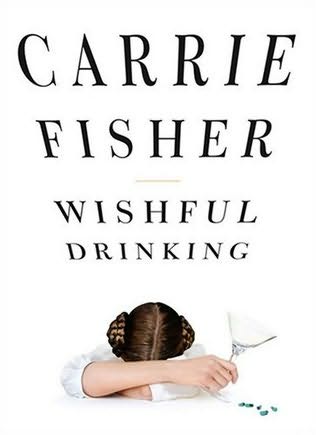
Wishful Drinking


Summary: In Wishful Drinking, Carrie Fisher tells the true and intoxicating story of her life with inimitable wit. Born to celebrity parents, she was picked to play a princess in a little movie called Star Wars when only 19 years old. "But it isn't all sweetness and light sabers."

Alas, aside from a demanding career and her role as a single mother (not to mention the hyperspace hairdo), Carrie also spends her free time battling addiction, weathering the wild ride of manic depression and lounging around various mental institutions. It's an incredible tale - from having Elizabeth Taylor as a stepmother, to marrying (and divorcing) Paul Simon, from having the father of her daughter leave her for a man, to ultimately waking up one morning and finding a friend dead beside her in bed.

Review: Reading Carrie Fisher's Wishful Drinking is like being in the audience of her one woman show: laugh out funny, but not a comprehensive memoir. After undergoing shock therapy to treat her depression and suffering the resulting memory loss, Fisher decides to tell her story both to reclaim memories and as a cathartic experience. Lucky us! Fisher has a gift in storytelling and doesn't hold much back in the way of secrets -- unlike a lot of Hollywood "tell alls" which tell little and are mainly PR pieces for the named celebrity.

Fisher's skewers various life episodes for our entertainment and hers. I laughed 'til I cried when I read Fisher's hysterical recounting of her family tree (with diagrams!) to explain to her daughter, Billie, who was interested in Elizabeth Taylor's grandson Rhys that "they are related by scandal." Fisher's mother Debbie Reynolds is portrayed as an eccentric (e.g. wanting to smoke pot with Fisher), but loving mother. While Fisher's father, Eddie Fisher, is described more by what he is not: an involved parent or even a mature adult. The remainder of this short tome addresses Fisher's bouts of depression, bipolarism, alcoholism, fame and rollercoaster relationship with Paul Simon. These are not usually funny subjects, but Fisher has a way with "gallows humor."

One note of caution: Fisher uses a fair amount of salty language and frankly describes several adult topics. Still if you are not easily offended and want a humorous, fast, read I highly recommend Wishful Drinking. Better still buy the audio version and let Fisher herself share the story that only she can tell!