Showing posts with label review nonfiction memoir. Show all posts

Friday, October 26, 2012

Good Stuff: A Reminiscence of My Father


Cary Grant loved being a dad and Jennifer Grant loved being his daughter.  In sharp contrast to the Mommy Dearest memoirs of Hollywood progeny, Good Stuff: A Reminiscence of My Father, reads like a love letter. On the twenty fifth anniversary of her father's passing, Grant shares memories on life with her famous father.  

There are no shocking revelations revealed, but rather Grant shares the small moments that make up the "essence" of Cary Grant. Fortunately, Grant had plenty of material to draw from.  Cary Grant was a regular archivist when it came to documenting Jennifer Grant's life and their time together including cassette tapes of conversations; drawings and notes; photographs; home movies; tickets from sporting events they attended and even newspaper articles clipped to provide advice or pass on Cary Grant's philosophy on life.  According to Grant, when Cary Grant became a father he walked away from show business entirely.  They never watched his films, discussed the industry or hung out with the Hollywood in-crowd (Cary Grant did maintain a few Hollywood friendships such as with Frank Sinatra, Johnny Carson, Gregory Peck and Quincy Jones, but these were based on longstanding personal ties).  Rather time was spent at home eating dinner around the table, playing cards or backgammon and other simple pleasures.  As Grant explains, "When I was at Dad's, he took full charge of my care. . . .  Dad awakened me each morning, drove me everywhere, ate meals with me, discussed life with me, and tucked me in each evening."  He even escorted her on trips to the local shopping mall!

When it comes to the rumors about her famous father, Grant firmly refutes them.  No Cary Grant wasn't gay, but apparently he enjoyed the misconception because "he said it made women want to prove the assertion wrong."  Also while Cary Grant appreciated the value of a dollar, he was no miser.  Cary Grant appreciated practical luxury and did not like to waste anything.  While I have no reason to doubt Grant's truthfulness her knowledge is limited to that of a daughter's and covers the last twenty years of Cary Grant's life.  And this is just fine with Grant:

In our heart of hearts, I believe we all know the skinny on people and situations.  We unconsciously block what's too much to process.  So somewhere inside . . . it's all there.  Other than that, I prefer knowing what I know . . . .   While there is a lot of stuff I certainly don't know, there's also a lot I do.     

Good Stuff is a touchingly sweet memoir about a devoted father who was also a Hollywood legend.

Friday, June 15, 2012

Blue Nights


Twenty months, that is all it took for Joan Didion’s world to be turned upside down. In the span of twenty months Didion lost her husband, author John Dunne, and her only child, Quintana Roo Dunne. From these tragic twin losses Didion has authored two powerful memoirs: The Year of Magical Thinking, which covers Didion’s first year of widowhood, and Blue Nights which reflects on her daughter’s life and the passage of time.

As Didion shares:
[A]ll seemed well when we were shaking off the leis onto the grass outside St. John the Divine on July 26, 2003. Could you have seen, had you been walking on Amsterdam Avenue and caught sight of the bridal party that day, how utterly unprepared the mother of the bride was to accept what would happen before the year of 2003 had even ended? The father of the bride dead at his own dinner table? The bride herself in an induced coma, breathing only on a respirator, not expected by the doctors in the intensive care unit to live the night? The first in a cascade of medical crises that would end twenty months later with her death? 

After experiencing these bookend losses in quick succession, it is amazing that Didion is still standing, let alone crafting beautiful, insightful, memoirs! Be warned, however, Didion’s writing style is not traditional i.e. “he said this and then she did that.” Rather reading Didion is akin to reading poetry: lines and themes are frequently repeated, but each time a new nuance is revealed.

 In Blue Nights, Didion skips between the past (raising her daughter and the insights gained in hindsight) and the present/future (what it means to grow old alone). On the parenting topic, Didion is a harsh judge of what she missed as a parent. For instance, Didion now realizes that Quintana displayed a high level of anxiety at a young age. On the subject of aging, Didion somberly confesses: “Could it be that I did not figure in either the general nature or the permanence of the slowing, the irreversible changes in mind and body, the way you wake one summer morning less resilient than you were and by Christmas find your ability to mobilize gone, atrophied, no longer extant?"  Notwithstanding the back and forth nature of the memoir, the mix between young motherhood and modern day frailty works well.

 I found Blue Nights to be profoundly sad, but a worthwhile read!


Reviewed based on personal copy.

Wednesday, June 13, 2012

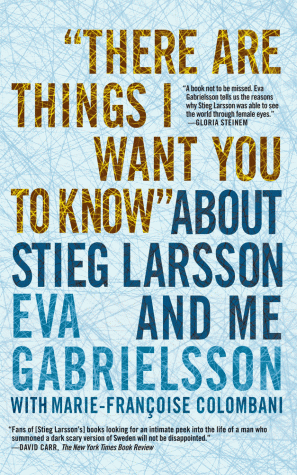
There are Things I want You to Know about Stiegg Larsson and Me


Write a will now! This is the takeaway message I got from reading Eva Gabrielsson's memoir of her thirty year relationship with Stiegg Larsson. Larsson, the author of the hugely successful Millennium series, died before his books were published and, hence, never lived to enjoy the literary and financial success his books have garnered. Sadly, he also died intestate (the legal term for without a will) which resulted in Larsson's father and brother being named as heirs to his estate and leaving his life partner Gabrielsson with nothing.
 
What I Want You to Know about Stiegg Larsson and Me, is not just a cautionary tale of greedy relatives, but also sheds light on Larsson's personal life and insight into the Millennium novels. In real life, Larsson was a voracious reader and autodidact. He believed passionately in social justice and was an ardent feminist. His political views led to him becoming a leading expert on extreme rightwing Nazi groups in Sweden and founding a progressive magazine. Larsson's career choice, however, subjected him to numerous death threats and is the reason why he and Gabrielsson never married (Swedish law required that married couples publically register their address).

As for inspiration behind the Millennium novels, Gabrielsson claims that the character Lisabeth Salander was conceived as modern day Pippi Longstocking. She also states that the main shared trait between Larsson and Mikael Blomkvist was their copious coffee consumption. Gabrielsson further notes that the stories that Larrsson penned were all derived from real life events (based either on his personal experience or newspaper stories) and that he liked to use names from people he knew in real life (although this is not true with respect to the main characters) and real addresses.

The memoir takes a dark turn, however, when Gabrielsson dishes on the legal matters that happened after Larsson's death. She is clearly very bitter which is understandable. Still I did not enjoy reading about the curse that she put on her enemies (presumably Larsson'a father and brother). Gabrielsson does have one ace in the hole: Larsson's unfinished fourth novel and outline for the rest of the series (he planned 10 novels in total). Hopefully, someday, Gabrielsson and Larsson's legal heirs can come to an agreement that will treat Gabrielsson more equitably and lead to the novel's eventual publication.

What I Want You to Know about Stiegg Larsson and Me is an informative book that Stiegg Larsson fans will (mostly) enjoy!


  Review based on a library copy.